The Community's Response to Harvard Moving In
Residents Determined to Preserve the Neighborhood
The Boston Redevelopment Authority (BRA) is Boston’s primary urban development agency. They are charged with the task of managing the planning and construction of the city’s various neighborhoods that are undergoing redevelopment. The BRA’s broad development authorities include the power to buy and sell property, the power to acquire property through eminent domain, and the power to grant tax concession to encourage commercial and residential development.
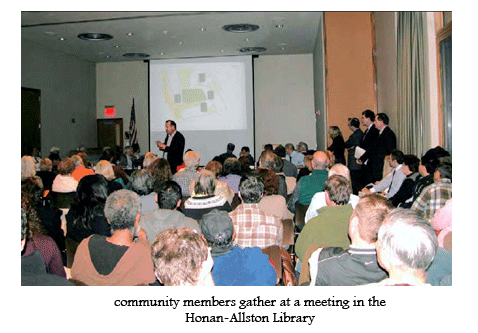
• Size of buildings will exceed suitable relative appeal for neighborhood, and skyscraper style complexes will create an urban “canyon” down the major thoroughfares
• The influx of cars and workers will inundate the area with too much traffic, creating congestion and increased demand on overloaded transportation systems and services
• Decades of construction will severely impact the existing neighborhood as massive complexes are built in the area
• The neighborhood will lose stewardship over an “overburdened, inaccessible, and inadequately maintained Charles River”
• Harvard housing and university spaces, including cultural centers and athletic areas, will not be integrated with the neighborhood, and tall fences will make bad neighbors as Harvard spaces will be inaccessible to N. Allston residents
• The economic opportunities that provide for families and “blue-collar” workers will be pushed out as a more upscale and expensive economic market moves in, much like that of current day Harvard Square in Cambridge
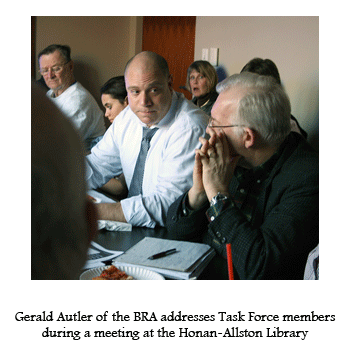
photo courtesy of Laura Melosh, of The Daily Free Press
These concerns are not explicitly mitigated in the current Institutional Master Plan, drafted in Jan 2007, and
Harvard has made no promises or outlined any solutions to these issues.
Yet the process is ongoing, and we should see Harvard respond to the community’s concerns throughout the
summer of 2008 and into 2009, when the BRA is set to finalized the first zoning licenses based on Harvard’s updated IMP.
Long time N Allston resident, Candy Lewis, talks about her neighborhood
.
N Allston resident, Harriet Kotomori, talks about how Harvard represented her neighborhood in their Institutional Master Plan
Brighton resident, David O'Connell, talks about university expansion in Allston
Boston University College of Communication 2008